
SECCIÓN RETRO
Addenda published in the Audiornis guides
Adendas publicadas en las guías Audiornis
PAPERS / ARTÍCULOS
07 Contributions to the knowledge of the Andean altitudinal range of the “Trilling” Miner (Geositta ‘fasciata’ giaii: Contreras, 1976) in Mendoza Province, Argentina
In prep.06 Confirmation of a new owl species (Strigidae: Bubo) endemic to the jalca of the Huancabamba Andean Depression, Peru
2026 Jul05 A new species of Steamerduck (Anatidae: Tachyeres) from the Chiloé region, Chile, finally confirmed as a taxon distinct from Tachyeres pteneres
2026 Feb04 The migratory route of the Migrant Miner (Geositta karinae, López-Lanús 2022): contributions to its knowledge through bioacoustic analysis at latitudinal extremes of the Pampas biome.
2025 Dec03 Confirmation of the historical records of the Dwarf Tinamou (Taoniscus nanus; Temminck, 1815) in the Province of Chaco, Argentina, and a surprising case of mere coincidence: its typical vocalisation emitted by a supposedly non mimicking resident oscine
2025 Sept02 Contribution to the knowledge of Chapman's Ocellated Crake (Micropygia schomburgkii chapmani; Naumburg, 1930) and the historical contribution of priest Pedro Blas Noseda
2025 July01 First description of the nest of the Ventania Yellow-finch (Sicalis holmbergi; López-Lanús, 2017) and comparison of egg colour with other yellow finches from the Southern Cone
2025 June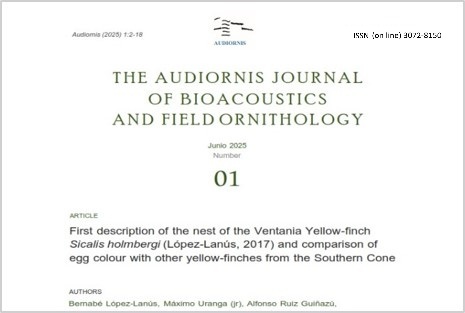
PUBLISHER / CONTACT
EDITORIAL / CONTACTO
An Ornithological Journal oriented in Taxonomy, Bioacoustics and Field Ornithology. Coverage area: South America with emphasis on the Southern Cone. Continuous delivery of isolated articles subject to material availability. Minimum bi annual submission in June and December. In PDF, online, bilingual (English/Spanish). Founded in 2025.
Una publicación periódica orientada a la taxonomía, bioacústica y ornitología de campo. Área de cobertura: América del Sur con énfasis en el Cono Sur. Entrega continua de artículos sujeto a disponibilidad de material. Entrega mínima bi-anual en Junio y Diciembre. En PDF, en línea (vía web), bilingüe (inglés/español). Fundada en 2025.
Editor: Bernabé López-Lanús
Email: bernabe.lopezlanus@gmail.com
WhatsApp: +54 9 11 2693 5103
Adress /Domicilio: Hipólito Yrigoyen 2697, departamento 3, Saladillo (7260), provincia Buenos Aires, Argentina
The editor, as founder, states that this space was created in response to a reality. Many ornithological works are not published despite their importance as a contribution to the knowledge of bird biology. This situation seems to be generated by the prevailing publication model, with a peer review system that allows the editor and readers to guarantee the quality of the published data. Although this method is applied without incident, when it is distorted by trends in thinking, professional political biases, cronyism, and so many other surprising human factors, it ceases to be objective. It has been proven that the principle of anonymity or non-anonymity of the reviewer has flaws in form and substance. In this journal, authors must thank their reviewers on their own initiative, announcing the name and suitability of the expert who reviews their paper (if necessary). In this way, the judgement of the quality of the published data becomes part of the history of ornithology rather than that of a handful of reviewers selected by the editor, and it is the public who decides on the usefulness of the data in exchange for it being published despite pressure from the system. In this way, the editor of this journal does not seek or suggest another publication system; on the contrary, he recommends that authors use well-known ornithology journals. Only in the event that a flaw in form and/or substance is perceived in the treatment given to an author by another journal will that author be considered for publication in this space. This last instance will necessarily involve topics covered by the journal, and the editor reserves the right of admission.
El editor, en calidad de fundador, manifiesta la creación de este espacio como una respuesta a una realidad. Muchos trabajos ornitológicos no llegan a ser publicados a pesar de su importancia como aporte al conocimiento de la biología de las aves. Esta situación pareciera estar generada en el modelo de publicación imperante, con un sistema de revisión por pares que permite al editor y los lectores garantizarse la calidad de los datos publicados. Si bien este método se aplica sin novedad, cuando se tergiversa por tendencias de pensamiento, sesgos políticos profesionales, amiguismo, y tantos otros factores humanos que sorprenden, deja de ser objetivo. Es comprobado que el principio de anonimato o no anonimato del revisor presenta vicios de forma y de fondo. En esta revista los autores deben agradecer motu proprio como condición a sus revisores, anunciando el nombre e idoneidad del experto que revisa su escrito (de ser necesario). De esta manera, el juzgamiento de la calidad de los datos publicados pasa a la historia de la ornitología más que a un puñado de revisores, y es el público el que decide la utilidad de los datos a cambio de que los mismos puedan ser publicados a pesar de la presión del sistema. De esta manera, el editor de esta revista, no busca ni sugiere otro sistema de publicación, por el contrario, recomienda a los autores la utilización de las revistas de ornitología ya conocidas. Sólo en el caso que se perciba vicio de forma y/o fondo en el tratamiento dado a un autor por otra revista, el mismo será considerado para publicar en este espacio. Esta última instancia, forzosamente con temas en los que esté orientada esta revista, además de que el editor se guarde el derecho de admisión.
RETRO SECTION
SECCIÓN RETRO
Addenda published in the Audiornis guides
Adendas publicadas en las guías Audiornis
There are five articles published as addenda in four editions of the book Guía Audiornis de Las Aves de Argentina (2015, 2017, 2019 and 2022), all printed on paper, either on demand or in print runs of hundreds of copies. These addenda are presented in this journal (The Audiornis Journal of Bioacoustics and Field Ornithology) with the numbers I, II, III, IV and V in the ‘Retro Section 2015-2022’, apart from the formal publications of the journal since 2025. Although these addenda have their own ISBNs because they appear as parts of a book, and have even been uploaded separately to the website www.archive.org, as a courtesy of Editorial Audiornis they are available in this space with the appropriate clarification.
Existen cinco artículos publicados como adendas en cuatro ediciones del libro Guía Audiornis de Las Aves de Argentina (2015, 2017,2019 y 2022), todas impresas en papel con ISBN, bajo el modoimpresión bajo demanada o con tiradas de cientos de ejemplares. Esas adendas son presentadas en esta revista (The Audiornis Journal of Bioacoustics and Field Ornithology) con la numeración I, II, III, IV y V en la “Sección Retro 2015-2022”, fuera de las publicaciones formales desde 2025. Si bien tales adendas presentan ISBN propio por aparecer como partes de un libro, y luego inclusive hayan sido subidas por separado en el sitio web www.archive.org , como una cortesía de la Editorial Audiornis quedan disponibles en este espacio con la aclaración del caso.
V
López-Lanús, B. 2022. On the taxonomic status of three recently
described Passeriformes: Sporophila digiacomoorum (López-Lanús, 2015),
Sicalis holmbergi (López-Lanús, 2017) and Cinclodes lopezlanusorum
(López-Lanús, 2019): ‘Putting the bell on the cat’ and the political bias of
ornithology. Addendum II. In pp. 574-595: López-Lanús, B. Audiornis Guide to
the birds of Argentina, photos and sounds; identification by opposing
characteristics and marks on images. Fifth edition. Audiornis Producciones.
Buenos Aires, Argentina. 640 pages.
ISBN 978-987-88-7537-8 (2022)
IV
López-Lanús, B. 2022. A new species of miner (Furnariidae: Geositta)
from the Patagonian region, a cryptic taxon immersed in migration in the
gaucho pampas of Geositta c. cunicularia (Vieillot, 1816). Addendum I. In pp.
551-566: López-Lanús, B. Audiornis Guide to the birds of Argentina, photos and
sounds; identification by opposing characteristics and marks on images. Fifth
edition. Audiornis Producciones. Buenos Aires, Argentina. 640 pages
ISBN 978-987-88-7537-8 (2022)
III
López-Lanús, B. 2019. A new species of Cinclodes (Furnariidae:
Cinclodes) in the Andean-Patagonian region, endemic and breeding in the
Lenga (Nothofagus pumilio) forests of arboreal morphotype. Addendum. In
pp. 475-509: López-Lanús, B. Guía Audiornis de las aves de Argentina, fotos y
sonidos; identificación por características contrapuestas y marcas sobre
imágenes. Third edition. Audiornis Producciones. Buenos Aires, Argentina. 544
pages
ISBN 978-987-783-666-0 (2019)
II
López-Lanús, B. 2017. A new species of endemic Yellow-Finch
(Thraupidae: Sicalis) from the mountains of the Ventania, pampa
bonaerense, Argentina. Addendum. In pp. 475-497: Guía Audiornis de las aves
de Argentina, fotos y sonidos; identificación por características contrapuestas y
marcas sobre imágenes. Second Edition. Audiornis Producciones. Buenos Aires,
Argentina. 524 pages
ISBN 978-987-42-3178-9 (2017)
I
López-Lanús, B. 2015. A new species of seedeater (Emberizidae:
Sporophila) from the Iberá waterlogged grasslands, Corrientes, Argentina.
Addendum. In pp. 473-489: Guía Audiornis de las aves de Argentina, fotos y
sonidos; identificación por características contrapuestas y marcas sobre imágenes.
First edition. Audiornis Producciones. Buenos Aires, Argentina. 522 pages.
ISBN 978-987-33-9633-5 (2015)